

5G Core Network Platform Key Features and Use Cases
2026-10-07
5G isn’t just faster internet—it’s a fundamental shift in how networks think. Yet most conversations stop at radio speeds, leaving the real engine—the 5G core—barely examined. This post unpacks the platform features that make a core truly cloud-native and the use cases turning those capabilities into revenue. From network slicing to edge integration, we look at what actually matters in deployment—and where IPLOOK fits in that picture.
From Monolith to Microservices: The Cloud-Native Shift in 5G Core
The move from monolithic architectures to microservices in the 5G core represents a fundamental rethink of how network functions are designed, deployed, and scaled. Traditional monolithic cores bundled multiple control-plane and user-plane functions into single, tightly coupled software stacks, which made upgrades risky, resource allocation inefficient, and vendor lock-in common. In contrast, the microservices approach breaks these functions into independently deployable services that communicate over lightweight APIs, allowing operators to scale only the components that actually need it—such as a sudden spike in authentication requests during a major event—without touching the rest of the core.
This shift is closely tied to cloud-native principles, where state is externalized, services are designed to fail gracefully, and orchestration platforms like Kubernetes handle lifecycle management. For example, the Session Management Function (SMF) or Access and Mobility Management Function (AMF) can each run as sets of stateless workers that pull session data from a distributed data store, rather than holding it in local memory. This not only improves resilience but also enables continuous delivery practices: a new version of a single microservice can be rolled out with canary deployments or blue-green strategies, drastically reducing maintenance windows compared to the big-bang upgrades of monolithic cores.
Operators adopting this model often face a steep learning curve, especially around observability, service mesh configuration, and inter-service latency budgets. Yet the payoff is a core network that behaves more like a modern web platform than a legacy telecom appliance—one that can absorb new radio access patterns, integrate third-party edge services, and evolve feature by feature without freezing the entire system. As 5G standalone cores become the default for new deployments, the microservices architecture is no longer an experimental option but the baseline expectation for vendors and integrators alike.
Network Slicing in Action: How One Core Powers Many Industries
A single physical core network was once seen as a blunt instrument—one size had to fit every service, from a heart monitor's millisecond pulses to a stadium full of video streams. Network slicing breaks that assumption. By partitioning the same underlying infrastructure into logical, end-to-end slices, operators can carve out virtual networks that behave like dedicated systems. Each slice carries its own resource guarantees, latency profile, and security policies, yet they all run side by side on shared hardware.
Consider a port automation system that needs deterministic sub-10-millisecond control loops for cranes and AGVs. That slice is configured with edge computing nodes and reserved radio resources, so a spike in consumer traffic never delays a container move. In the same city, a telemedicine slice runs parallel, prioritizing ultra-reliable low-latency links for telesurgery while a third slice handles massive IoT sensor data from smart buildings—aggregating small packets without overwhelming the signaling plane. One core, three radically different service contracts, all isolated from each other's failures.
The Service-Based Architecture Advantage: APIs, Agility, and Beyond
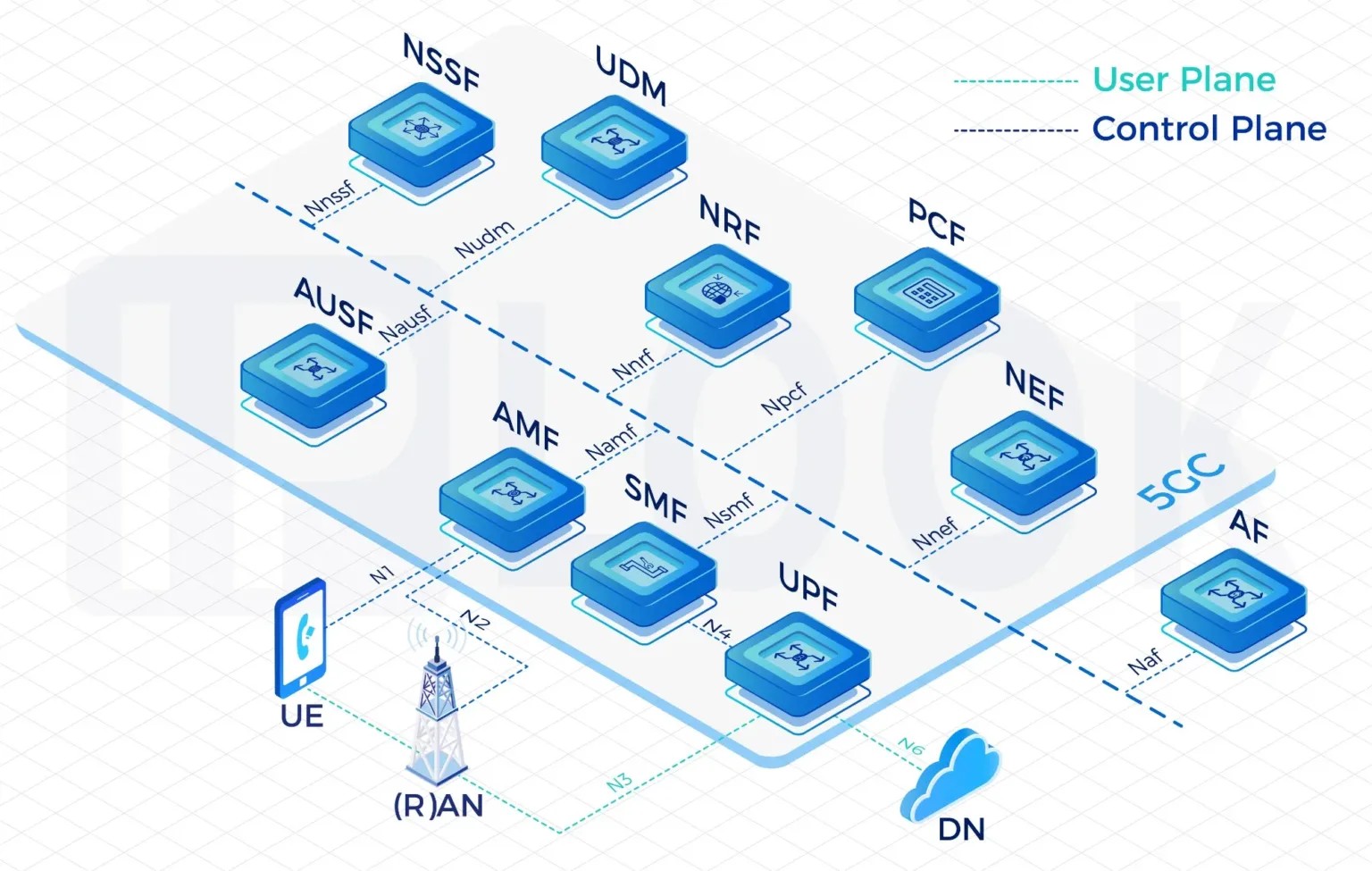
Service-based architecture turns monolithic applications into a set of focused, independently deployable services. At its core, the approach replaces tight internal coupling with clear API contracts, letting teams evolve each service on its own schedule. Rather than forcing a single database or shared runtime, services communicate over well-defined interfaces, which means a change to billing logic no longer requires redeploying the entire user-facing stack. This structural shift reduces coordination overhead and makes it practical for multiple teams to work in parallel without stepping on each other's toes.
The agility gain is not just about speed of deployment—it is about speed of decision-making. Because each service owns its data and behavior, teams can choose the right tool for the job: a graph database for social connections, a relational store for orders, a queue for asynchronous events. The API boundary acts as a stable contract, so internal implementation details stay hidden. When a new requirement appears, the affected service can be extended or replaced with minimal ripple effects. This contrasts sharply with monoliths, where even small changes often require broad regression testing and lengthy release cycles.
Beyond technical delivery, service-based architecture encourages a mindset of product ownership. Teams stop thinking in terms of horizontal layers and start thinking in terms of business capabilities: checkout, inventory, recommendations. Each capability becomes a service with a clear owner, explicit metrics, and a defined failure boundary. This ownership reduces handoffs and finger-pointing, while observability across API calls makes bottlenecks visible. The result is not just faster releases but a more resilient system—one where failures are contained, scaling is targeted, and the architecture mirrors the organization's real-world priorities.
Pushing Intelligence to the Edge: 5G Core’s New Frontier
The 5G core is quietly redefining where decisions happen. Instead of hauling every byte back to a distant data center, network functions like the Session Management Function and User Plane Function now steer traffic toward edge nodes that sit closer to subscribers. This isn’t just about trimming milliseconds—it’s about giving applications room to behave differently. A factory floor can run real-time visual inspections without a round-trip to the cloud, and an AR overlay can adjust to a user’s movement without perceptible lag.
That shift forces a rethink of control. The core still owns policy and authentication, but it delegates execution to edge-local instances that must be managed as a single logical fabric. Service providers are discovering that the hard part isn’t spinning up another UPF outpost—it’s keeping routing, QoS, and security coherent when intelligence is spread across dozens of sites. The operators who master this distributed choreography are the ones turning “edge” from a buzzword into a measurable advantage.
Self-Healing and Automated: The Operational Backbone of Modern Core
A modern core earns its keep during the messy hours—when a stateful function loses quorum, a user plane instance starts dropping sessions, or a software update leaves one region running a mismatched configuration. Self-healing in this environment isn't a single watchdog process; it's a distributed habit. Health probes run constantly, reconciliation loops compare actual state against declared intent, and the control plane rebalances capacity before alarms escalate. The aim is not to eliminate failure but to shrink its radius to something almost invisible.
Automation gives that self-healing behavior a backbone. Instead of relying on heroic engineers to scroll through dashboards at 2 a.m., the core encodes recovery steps as policy: drain traffic from a suspect instance, restart it in a clean state, verify session continuity, and only then return it to rotation. These closed loops operate on telemetry that is far richer than traditional SNMP traps—latency histograms, queue depths, certificate expiry, memory pressure—so the system can act on leading indicators rather than waiting for hard failures.
Operationally, this shifts the team's focus from response to refinement. When the core can handle routine drift and localized faults on its own, the remaining human work becomes tuning thresholds, auditing recovery playbooks, and stress-testing failure scenarios in staging. The result is a core that doesn't just survive change—it uses change as a signal to prove its resilience, release after release.
Built-In Security: Why 5G Core Trusts Zero Trust
The 5G core's shift to a service-based architecture dismantled the old perimeter model. Network functions no longer sit behind a single fortified boundary; they communicate over HTTP/2 APIs across cloud-native infrastructure that can span multiple vendors and data centers. Every request between an Access and Mobility Management Function, a Session Management Function, or a Network Repository Function is a potential entry point. A zero-trust posture matches this reality: no message is accepted simply because it arrived from inside a trusted zone. Each inter-service call carries mutual TLS and token-based authorization, verifying identity and scope before the request touches policy or session data.
This is not an afterthought bolted onto the core; the 3GPP specifications bake zero-trust controls into the control plane. Network functions register with the NRF, discover peers dynamically, and then authenticate every API invocation. By keeping permissions granular and ephemeral, a compromised user plane or edge node cannot freely roam across the control plane. As operators deploy 5G core functions across public, private, and edge clouds, that built-in skepticism toward every packet and call is what holds the architecture together.
FAQ
Instead of relying on fixed, point-to-point interfaces, each network function exposes services through a common bus. This lets operators add, upgrade, or scale individual components without redesigning the whole core. It also simplifies integration with third-party applications and supports automated lifecycle management.
By splitting the control plane from the user plane, data traffic can be routed locally at edge sites while signaling still goes to a central controller. This shortens the path for latency-sensitive applications like augmented reality or industrial automation, since packets no longer need to traverse the entire core network.
Network slicing creates multiple logical networks on top of one physical infrastructure. Each slice gets its own resources, quality-of-service policies, and security settings. For instance, a smart factory might use one slice for real-time robot control with ultra-low latency and another slice for video surveillance with high bandwidth, both running independently on the same core.
Cloud-native principles, such as microservices and containers, let network functions be deployed across distributed data centers. This enables rapid scaling, failure isolation, and continuous delivery. Operators can roll out new features in days instead of months, which is essential for keeping pace with changing enterprise demands.
The core supports efficient signaling for a huge number of devices without overwhelming the network. It can group devices, apply power-saving modes, and use lightweight protocols. This makes it practical to connect sensors, meters, and trackers that transmit small data packets intermittently over long periods.
It uses stronger authentication mechanisms, encrypted interfaces between functions, and built-in security for roaming scenarios. Network slicing also isolates traffic so a breach in one slice does not spread to others. Additionally, the core can enforce security policies dynamically based on subscriber type or service requirements.
Remote surgery requires guaranteed latency under a few milliseconds with no packet loss, which the core can provide through dedicated slices and edge-based user plane placement. Autonomous vehicles use similar capabilities for vehicle-to-everything communication, while industrial robots rely on the core's deterministic scheduling to avoid collisions on factory floors.
The core can deliver high-throughput, low-latency data streams by placing user plane functions close to the venue. This allows multiple users to experience synchronized AR or VR content without excessive buffering. The service-based architecture also makes it easy to spin up temporary slices for events like concerts or sports matches.
Conclusion
The 5G core has abandoned the rigid, monolithic architectures of previous generations in favor of a cloud-native, microservices-based design. Each network function runs as an independent, containerized service, allowing operators to scale, upgrade, and failover components without disrupting the entire system. This shift is what makes network slicing truly practical: a single physical core can be partitioned into multiple logical slices, each tailored to the latency, bandwidth, and reliability requirements of different industries—from autonomous vehicles demanding ultra-low latency to massive IoT deployments needing only sporadic, low-power connectivity. The service-based architecture underpins this flexibility by exposing network capabilities as consumable APIs, enabling dynamic service composition, third-party innovation, and faster time-to-market for new features.
Operationally, the modern core is built to run itself. Closed-loop automation and self-healing mechanisms continuously monitor network health, predict failures, and trigger corrective actions without human intervention, while edge computing capabilities push user-plane functions closer to the point of data generation to reduce backhaul load and improve response times. Security is no longer an afterthought but an embedded, zero-trust principle: every request is authenticated, authorized, and encrypted, regardless of whether it originates inside or outside the network perimeter. Together, these capabilities transform the 5G core from a static packet-forwarding engine into an agile, intelligent platform that can serve as the foundation for industrial automation, smart cities, immersive entertainment, and critical communications—all on the same infrastructure.
Contact Us
Contact Person: Shimmy
Email: [email protected]
Tel/WhatsApp: 85253392231
Website: https://www.iplook.com