

Best CNC Press Brake Options for Precision Metal Fabrication
2026-09-20
When every bend counts, the difference between a perfect part and costly scrap often comes down to one machine. Precision metal fabrication demands more than raw force—it requires repeatability, control, and smart design. That’s where the right CNC press brake makes its mark. Among the options worth your attention, HUNSONE stands out for fabricators who refuse to compromise on accuracy or efficiency.
What Actually Defines Precision in a CNC Press Brake
Precision in a CNC press brake rarely comes down to a single specification. It emerges from the interplay between the machine's frame rigidity, the consistency of the hydraulic or electric drive system, and the accuracy of the backgauge positioning. A rigid frame reduces deflection under load, which directly affects how evenly the bend forms along the entire length of the workpiece. Meanwhile, the control system's ability to compensate for material springback and thickness variations separates a machine that produces repeatable angles from one that drifts after the first few parts.
Another key factor is thermal stability. Hydraulic systems generate heat, and as oil temperature rises, viscosity changes, which can subtly alter ram speed and position. High-end press brakes use real-time thermal compensation algorithms to keep the ram position accurate regardless of operating temperature. Electric press brakes, by contrast, offer a different advantage: their servo-driven ball screws or belt drives eliminate oil temperature fluctuations altogether, but they require precise torque control to avoid slight positioning errors under load.
Finally, the tooling and clamping system cannot be overlooked. Even the most sophisticated CNC control cannot correct for worn or poorly seated punches and dies. Precision is maintained when the tool holders use hydraulic or mechanical clamping that applies uniform pressure, and when the tooling itself is ground to tight tolerances. In practice, shops that measure their bend angles with laser or mechanical angle sensors and feed that data back into the controller achieve the tightest tolerances, because the machine learns from each bend rather than relying on theoretical calculations alone.
Hydraulic vs. Electric Drives: How Each Affects Bend Accuracy
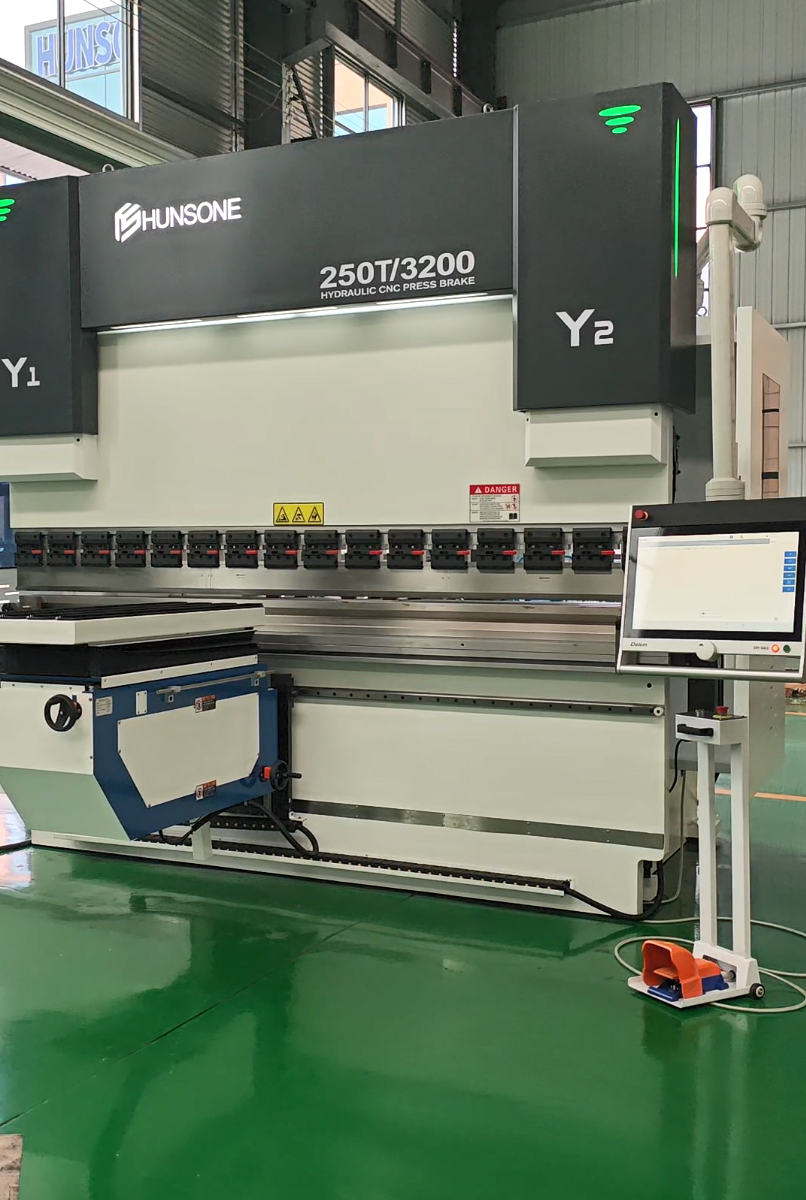
Hydraulic drives have long been the workhorse of press brakes, using pressurized fluid to move the ram. While they excel at generating high tonnage, their accuracy can drift with oil temperature, viscosity changes, and seal wear. As the hydraulic fluid heats up during a production run, the ram's positioning may shift by a few thousandths of an inch, which is enough to alter bend angles on tight-tolerance parts. Electric drives, by contrast, rely on servo motors and ball screws or belt drives. They hold position with remarkable repeatability because there is no fluid compressibility or thermal expansion of oil to compensate for. The result is often a more consistent bend angle from the first part to the last, especially on smaller machines where speed and precision matter more than raw force.
Another factor is how each system handles dwell time and reversal. Hydraulic systems can exhibit a slight delay or overshoot when the ram changes direction, which can cause inconsistent material springback compensation. Electric drives provide near-instant response to control signals, allowing the ram to stop and reverse at precisely the same point every cycle. This tighter control loop means operators spend less time adjusting for drift and can hold bend accuracy over longer unattended runs. However, hydraulic systems still dominate in thick plate and high-force applications, where the sheer power masks some of the precision limitations that would be unacceptable in lighter gauge work.
Maintenance also plays a subtle role. Hydraulic oil degrades over time, filters clog, and valves wear, all of which introduce variability in ram positioning. Electric drives have fewer wear components in the motion path, so their accuracy remains more stable between service intervals. In practice, shops that switch from hydraulic to electric press brakes often report a measurable reduction in angle variation, particularly for parts made from high-strength steels that are sensitive to over-bending. The trade-off is that electric machines may have lower maximum tonnage, so the decision ultimately hinges on the material thickness range and the tolerance stack-up of the parts being formed.
Why Crowning Systems Matter More Than Tonnage
Tonnage tends to get all the attention when shops compare press brakes, but raw force alone rarely dictates bending quality. Under load, every machine frame, ram, and bed deflects to some degree. That deflection is not uniform across the working length—center sections typically bow more than the ends, which means the punch and die gap changes from one side to the other. A high-tonnage machine with uncontrolled deflection will still produce angles that vary by half a degree or more across a long part, regardless of how much pressure it can exert.
Crowning systems address this by compensating for deflection in real time, usually through hydraulic or mechanical wedges built into the bed or upper beam. Instead of simply pushing harder, the machine adjusts its geometry to keep the tooling parallel under actual bending forces. This directly improves angle consistency, reduces the need for test bends, and lets operators hold tighter tolerances on materials with varying thickness or tensile strength. In many cases, a mid-tonnage brake with an effective crowning system outperforms a much larger machine that relies only on brute force and operator shimming.
From a practical standpoint, the difference shows up quickly on long parts like enclosure panels or structural channels. With proper crowning, the bend angle stays within a few tenths of a degree from edge to edge; without it, even a small error means rework, scrap, or excessive spot-checking. Tonnage determines whether you can bend a given thickness at all, but crowning determines whether you can bend it consistently enough to ship. That consistency—not maximum force—is what keeps downstream assembly and welding from becoming a daily headache.
Backgauge and Tooling Choices That Improve Repeatability
Repeatability starts with treating the backgauge as a hard stop rather than a suggestion. Even a well-built CNC press brake will produce scattered angles if the backgauge fingers shift slightly between parts. Use rigid fingers with flat contact faces and position them close to the bend line where the sheet has less room to bow. When flipping a part for multiple bends, keep the same reference edge rather than alternating — this removes one variable that quietly erodes batch consistency.
Tooling choices carry just as much weight. Mixed or worn punch segments create localized deflection, so a full-length punch or a set of segments matched by height and usage history tends to hold a straighter bend. The die opening also matters: a wider V reduces tonnage but increases sensitivity to thickness variation, while a narrower V gives a sharper, more repeatable bend at the cost of higher load. Aligning the tooling to the ram centerline and checking clamp tightness after setup prevents the slow drift that shows up as angle change by mid-run.
Matching Press Brake Size to Real Fabrication Workflows
Choosing the right press brake size rarely comes down to just tonnage and bending length. It starts with mapping out the parts you actually run week to week. A shop that mostly forms thin-gauge aluminum panels has very different needs from one bending thick steel brackets or long structural channels. If you size for the biggest occasional job, you often pay for capacity that sits idle while everyday setups become more awkward than they should be.
Workflow matters as much as workpiece dimensions. Consider how material flows into and out of the brake, whether operators handle large sheets alone or with a helper, and how often tooling changes happen. A machine with a slightly longer bed or higher open height can reduce handling time even when the extra capacity is rarely used at full force. Small differences in throat depth or stroke length can determine whether a bend is a smooth single pass or a series of repositioning moves.
The practical approach is to let the majority of your production drive the decision, then look for a brake that handles that work comfortably while still leaving room for realistic exceptions. Tonnage charts and bend length guides are useful, but they do not capture the pace of your shop floor. When the brake fits the way people actually work, setup time drops, material moves faster, and the machine earns its footprint every day.
Maintenance Habits That Keep Precision from Drifting
Most drift issues start with neglected surfaces. Wiping down ways, spindles, and reference edges after every shift removes the fine grit that slowly changes contact points. A quick pass with a lint-free cloth and a check for burrs or coolant buildup takes less than five minutes, but it stops tiny deviations from becoming permanent offsets.
Fasteners and gib adjustments deserve a scheduled torque check, not just an occasional glance. Vibration from normal cutting or repeated cycling works bolts loose in ways that aren't visible until the machine has already shifted. Use a torque wrench on mounting bolts and re-check gib tightness at intervals based on actual run hours. Also keep chips out of leadscrews and way covers; compressed air can push debris deeper, so a brush or vacuum often works better.
Finally, record drift instead of chasing it blindly. Run a consistent warm-up cycle before measuring, note backlash and zero return errors in a simple log, and compare week-over-week. When a machine needs calibration more often than the manual suggests, treat that as a signal from the equipment, not a sign to adjust the schedule. Small corrections made early are cheaper than rework after parts have already gone out of tolerance.
FAQ
Focus on frame rigidity, repeatable backgauge systems, and a control that stores tooling data. Hydraulic or electric drives with closed-loop feedback usually hold plus or minus 0.0004 inch over long runs. Also check crowning systems because deflection under load quietly ruins accuracy.
They often are if you run thin sheet or need fast cycles. Electric brakes consume less energy, warm up faster, and avoid hydraulic oil temperature drift. Hydraulic still wins for very thick, high-tonnage jobs.
Look for off-line programming, 3D simulation with collision detection, and automatic bend allowance correction. A clear library for tooling and materials saves more time than most people expect.
Four-axis handles most basic parts with depth and height. Six-axis adds lateral and rotation adjustments, which helps with complex profiles, multiple bend sequences, and flanges that would otherwise collide with fingers.
Regular calibration of the backgauge and ram, checking hydraulic fluid cleanliness, and keeping guides and ball screws clean. Also monitor crowning cylinders because uneven wear there causes inconsistent angles across the bed.
Amada, Trumpf, Bystronic, and LVD have strong reputations. Each has different strengths: Amada for fine control, Trumpf for automation, Bystronic for fast setups, LVD for adaptive bending. Test with your own material before committing.
Yes, often. Retrofitting a modern CNC control, servo-driven backgauge, and laser angle measurement can bring a solid frame back to tight tolerance. Check frame wear and ram parallelism first.
Thickness variation, grain direction, and springback vary between batches. Use a machine with angle correction and material library to compensate. For stainless or high-strength steel, consider a press brake with higher tonnage reserve and slower forming speeds.
Conclusion
Precision in a CNC press brake isn't just a spec sheet number—it's how consistently the machine holds angle and flange length across a full sheet of parts. Hydraulic drives can offer brute force and are familiar, but electric servo drives typically deliver tighter repeatability because they eliminate oil temperature drift and valve lag. That doesn't mean hydraulics are obsolete; a well-maintained hydraulic system with proportional valves can still hit tight tolerances on thinner stock. The real differentiator is crowning. A machine with automatic crowning adjusts for bed deflection under load, keeping the bend angle uniform from edge to edge. Without it, even a high-tonnage brake will produce banana-shaped parts on long bends.
Backgauge and tooling choices quietly determine how repeatable a setup really is. Multi-axis backgauges that move independently let you stage flanges of different lengths without re-fixturing, while precision-ground tooling with hardened surfaces reduces wear that silently opens bend angles. Matching press brake size to actual workflow matters more than buying the biggest bed you can afford; a 6-foot electric brake with proper tooling often outperforms a 10-foot hydraulic that rarely sees full-length work. Finally, maintenance habits—greasing guides, checking hydraulic oil cleanliness, recalibrating the backgauge every few months—keep precision from drifting. The best option is the one that fits your typical material thickness, batch sizes, and operator skill, not just the one with the highest tonnage.
Contact Us
Contact Person: James Chen
Email: [email protected]
Tel/WhatsApp: 86 13770803946
Website: https://www.hunsone.com/