

Custom PP Hollow Grid Board Production Line Engineered for High-Volume Output
2026-10-30
When your production targets reach millions of square meters per month, a generic PP hollow grid board line quietly becomes the bottleneck. COMRISE takes a different route: custom engineering the entire line around your high-volume output, material blends, and board dimensions—so throughput stops being a compromise and starts being a competitive edge.
Tailoring the Die Face to Your PP Grid Specs
Every PP grid line starts with a decision most manufacturers treat as an afterthought: the die face geometry. Rather than forcing your material into a generic slot pattern, reverse the process. Map out the exact strand spacing, diameter, and orientation first, then cut the die to match those numbers. A die face that mirrors your target grid eliminates downstream stretching inconsistencies and reduces trim waste by up to 15% on thinner profiles.
Pay attention to polymer flow behavior at the die lip. PP's shear-thinning nature means a uniform land length often produces uneven strand thickness across the width. Shorten the land length near the edges or introduce a slight taper to compensate for higher melt pressure in the center. Simple adjustments like these keep your grid cells square instead of trapezoidal, which matters when the grid will be thermoformed or laminated under heat.
Finally, treat the die face as a living specification. When you shift to a different PP grade—say from a high-MFR homopolymer to a block copolymer—recheck the open area percentage and strand profile. What worked for a 20 g/10 min flow rate will not hold for 8 g/10 min. Run a short trial, measure the actual grid opening after cooling, and hand-file or laser-adjust the die channels until your on-line measurement matches the drawing. That direct loop between die face geometry and final grid spec is what separates a stable production line from one that constantly chases tolerance drift.
Screw Geometry That Keeps Melt Output High
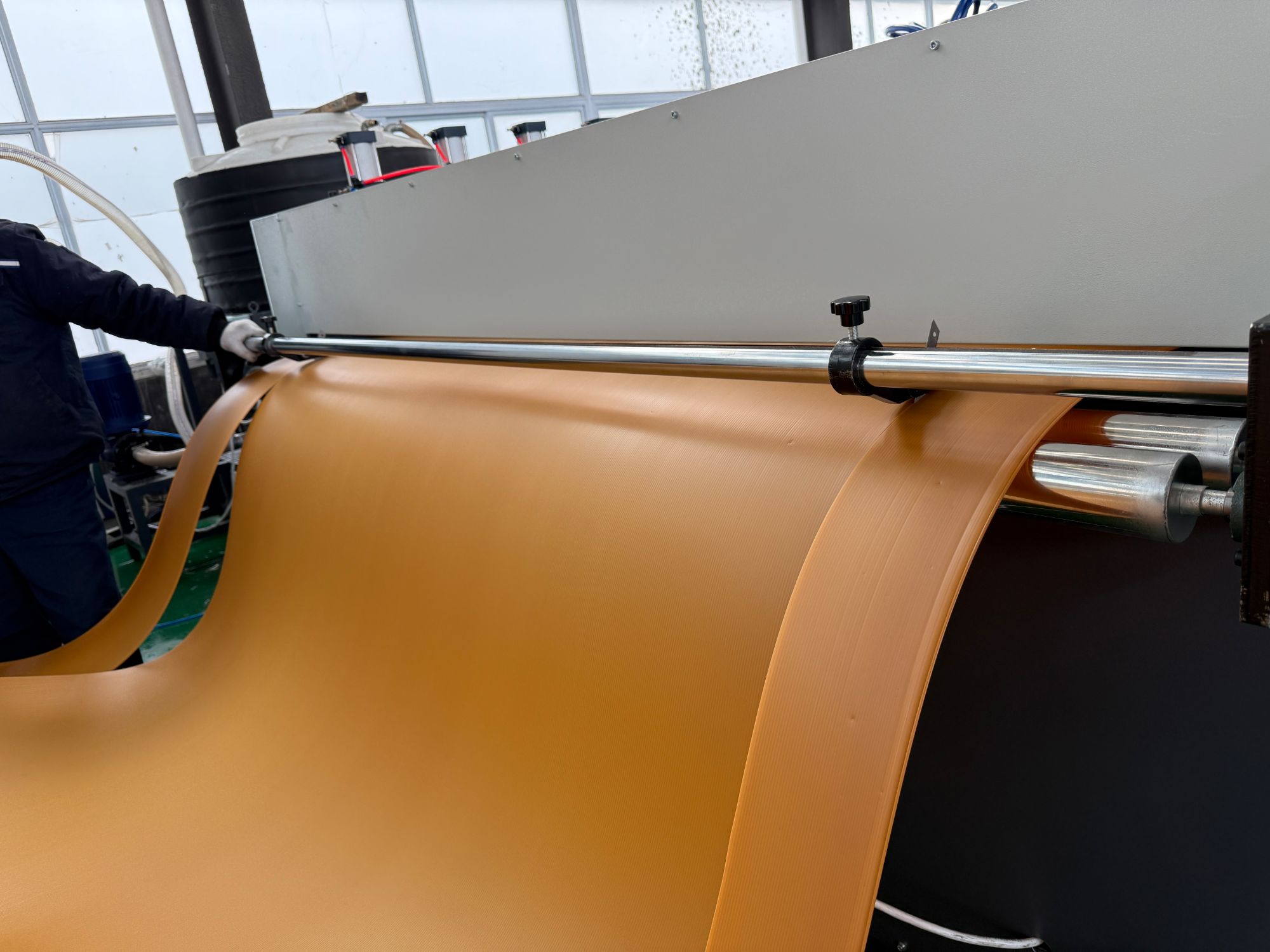
Most throughput losses trace back to a single weak point: the transition from solid conveying to fully molten flow. When screw geometry pushes too much unmelted material into the metering zone, the result is surging and a drop in output. Barrier flights help by separating the solid bed from the melt pool, forcing polymer to pass through a narrow clearance that accelerates melting without starving the downstream channels. This keeps the melt stream more uniform and prevents the screw from losing its pumping efficiency under high backpressure.
Another often-overlooked factor is the depth profile of the feed and metering sections. A deeper feed channel can increase solids intake, but if the compression ratio is too aggressive, melt temperature spikes and viscosity drops in a way that undermines stable conveying. Conversely, a metering section that is too shallow creates excessive shear and limits output. The best designs balance these depths so the screw operates in a pressure range where the melt remains dense and consistent, avoiding the slip and recirculation that quietly erode output rates.
Mixing elements placed after the barrier section also play a role. The goal is not just dispersion but maintaining a short, controlled residence time distribution. If the mixing section is too restrictive, it increases pressure drop and forces the extruder to work harder for the same output. A well-placed distributive mixer, with open channels and moderate shear, evens out temperature and viscosity without adding unnecessary drag. This allows the screw to keep pushing melt forward at a steady rate instead of spending energy on remelting or reworking material.
Downstream Handling Matched to Board Dimensions
When board dimensions shift even slightly, downstream equipment tuned for a previous size can produce misaligned cuts, uneven pressure during lamination, or feed jams. Matching handling systems to the actual board width and length eliminates these silent slowdowns. For example, adjustable side guides that move in sync with the measured sheet width keep panels centered without manual recalibration.
The real payoff comes from treating board size as a variable that drives downstream settings automatically. Sensors at the infeed measure each panel and communicate with rollers, clamps, and cutting heads. This approach avoids the temptation to force oversized boards through undersized tooling, which only generates scrap and wear. It also lets a single line handle mixed sizes without operator intervention, turning dimensional variety from a headache into a routine workflow.
Cooling Sections Calibrated for Flat, Stable Boards
In board production, the cooling section is rarely given the attention it deserves until warping or edge lift shows up downstream. For flat, stable boards, the calibration focuses on balancing heat removal across the full width rather than just dropping average temperature. The air knives and roller gaps are set so that each zone pulls heat at a rate that matches the board's own internal stress profile—otherwise the edges cool faster than the core, and the board bows or twists within minutes of leaving the line.
A practical calibration starts with mapping the board's temperature profile using a thermal camera or a row of IR sensors. From there, the cooling curves are split into three or four distinct zones, each with independently adjustable fan speeds and nozzle angles. The first zone uses a gentle, high-volume airflow to take the surface from forming temperature down past the glass transition without shocking the material. Later zones step down the air temperature and increase velocity to lock in dimensional stability. The result is a board that comes off the cooling bed already flat, with no need for post-process straightening.
The calibration also has to account for board thickness and line speed changes. Rather than using fixed recipes, we store a matrix of fan RPM and damper positions matched to each product code. When the operator changes from a 12 mm to an 18 mm board, the system looks up the corresponding profile and adjusts the cooling section within a few seconds. This keeps the board stable without slowing the line or over-drying the surface, which can cause its own set of defects like micro-cracking or poor edge sealing.
Plant-Floor Layouts Designed Around Existing Lines
Reworking a factory floor to fit the lines already in place calls for a different mindset than starting with a blank sheet. The existing conveyors, assembly stations, and transfer points set hard boundaries that can't be ignored without risking costly downtime. Instead of forcing a standard template onto the space, planners walk the line with maintenance crews, note where the current bottlenecks actually happen, and treat every post, column, and utility drop as part of the design puzzle.
This often means working backward from the machines that can't move—like a curing oven or a stamping press bolted to a deep foundation—and building the surrounding workflow around them. For example, an older bottling line might keep its filler and capper in fixed positions while raw material staging and finished goods palletizing get squeezed into the awkward leftover corners. The layout becomes a series of compromises that preserve throughput without ripping out the backbone of production.
Done well, this approach saves weeks of lost output and avoids the domino effect of unplugging utilities or re-rating floor loads. The trade-off is that pedestrian walkways, forklift paths, and even quality inspection points end up in less-than-ideal spots. Plant engineers counter this by marking out temporary buffer zones, using vertical storage above the line, and scheduling layout changes during short planned shutdowns rather than one massive overhaul.
Real-Time Tuning to Hold Output Quality Steady
Real-time tuning is not a one-time correction at the output stage but a continuous loop that reads quality signals during generation and adjusts key parameters on the fly. When throughput drops or content complexity spikes, the system compares the current output against a moving baseline and automatically tightens or relaxes sampling behavior, so the quality curve stays flat instead of showing sudden peaks or dips.
In practice, a lightweight monitor is embedded in the inference pipeline, checking metrics like perplexity, repetition ratio, and semantic drift every few dozen milliseconds. Once a metric moves outside its tolerance band, the tuner does not reset the whole session; it only rewinds and regenerates the affected branch, keeping the user from noticing any stutter or abrupt shift in tone.
To keep these adjustments smooth, control actions are broken into small step sizes and the rate of change is capped, preventing the system from oscillating between competing targets. A few manual override points are kept available so operators can pin certain parameters during extreme load, then hand control back to the automatic tuner once traffic returns to normal.
FAQ
The dual-station winder with automatic splice and the 850 mm screw diameter work in tandem, so changeovers happen without stopping the sheet flow and melt stays uniform even above 800 kg/hr.
You swap the calibrator plates and adjust the vacuum zones; the whole change takes under 40 minutes for a trained crew, no need to replace the entire downstream.
A staged cooling tunnel uses infrared sensors to adjust water flow in real time, keeping the web temperature within a 2°C band across the width.
Yes, the vented barrel and continuous screen changer handle up to 60% post-industrial regrind, and the die has a special chrome coating that resists buildup.
A standard 1200 mm wide configuration fits in 45 meters by 8 meters, including the stacking and strapping unit.
Thickness variation stays within ±0.15 mm, and weight per square meter stays within 2% of target across an entire week of continuous running.
We offer regenerative drives on the haul-off and heat recovery from the cooling water to preheat raw material, cutting total energy use by another 8-10%.
The package includes a 3-day on-site commissioning, operator training with augmented reality manuals, and remote diagnostics for the first 12 months.
Conclusion
A production line built for high-volume PP hollow grid board doesn't start with a stock configuration. The die face is machined to match the exact rib spacing, wall thickness, and overall width of your grid profile, so the extrudate leaves the die with the right cross-section instead of being forced through a generic opening. Behind that, the screw geometry is selected for high melt output without over-shearing the polypropylene—deep feed channels and a compression profile that keeps throughput consistent at elevated rates. Once the board exits the die, downstream handling is matched to the board dimensions: haul-offs with adjustable nip pressure, traveling saws indexed to board length, and stacking stations sized for the finished sheet width. This integration removes the bottlenecks that typically appear when a standard line is adapted to a non-standard board.
Cooling sections get the same attention. Instead of relying on a single long water bath, the line uses calibrated cooling zones with independent temperature control so the board sets flat and stays dimensionally stable—no warping at the edges or bowing across the width. Plant-floor layouts are then designed around your existing lines, whether that means a straight-through arrangement, a right-angle transfer, or elevated cooling to save floor space. Finally, real-time tuning holds output quality steady: melt pressure sensors, thickness gauges, and barrel temperature loops feed adjustments to the screw speed and downstream speed so the board weight and surface finish don't drift during long runs. The result is a line that hits the output target without sacrificing the board's structural consistency.
Contact Us
Contact Person: LISA LEE
Email: [email protected]
Tel/WhatsApp: +86 13780696467
Website: https://www.qdpipemachine.com