

Phenylacetonitrile Intermediate Top 10 Compounds for Organic Synthesis
2026-11-16
When building complex molecules, the right nitrile intermediate can make or break a route. Phenylacetonitrile and its close derivatives quietly power some of the most useful transformations in modern organic synthesis—yet they rarely get the attention they deserve. In this post we’ve ranked ten standout phenylacetonitrile-based intermediates by synthetic versatility, availability, and handling profile. Whether you’re planning a heterocycle synthesis, a cross-coupling sequence, or a large-scale reduction, this list is designed to help you choose faster. For reliable sourcing and technical data on these building blocks, the team at DSL Chemicals has built a focused portfolio worth checking out.
Why Phenylacetonitrile Keeps Showing Up in Retrosynthetic Plans
Phenylacetonitrile earns its frequent cameo in retrosynthetic plans largely because one compact structure packs three distinct handles. The benzylic protons are acidic enough to be removed with alkoxide or amide bases, generating a nucleophilic carbanion that will alkylate, add to carbonyls, or open epoxides without much fuss. That same intermediate can be viewed as a benzyl anion equivalent, which is not always trivial to install otherwise. The nitrile itself is more than a spectator: it pulls electron density, stabilizes the adjacent anion, and survives conditions that would destroy many other carbonyl-derived activating groups.
Just as important is what happens after the coupling step. The cyano group can be reduced to a primary amine, hydrolyzed to a carboxylic acid, partially reduced to an aldehyde, or converted into an amide. In a retrosynthetic sense, this means a phenylacetonitrile fragment can stand in for several different final functional groups depending on how the route unfolds. That flexibility lets a single disconnection serve multiple targets, reducing the number of distinct starting materials a lab needs to keep on hand.
There is also a practical angle. The compound is inexpensive, available in bulk, and easy to handle compared with more specialized benzyl or acyl anion precursors. Its reactions tend to be robust on scale, and the byproducts are usually simple salts or ammonia derivatives. When a retrosynthetic tree branches toward a benzyl-substituted amine, acid, or nitrile, phenylacetonitrile often appears because it is the shortest path from a stable bottle on the shelf to the desired carbon skeleton.
Ten Building Blocks That Start from the Same Benzylic Nitrile
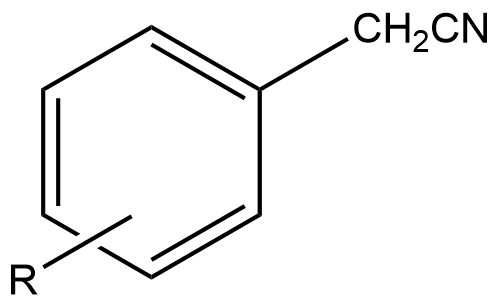
A single benzylic nitrile can be coaxed into a surprising range of molecular frameworks by treating it less as a finished intermediate and more as a latent handle for selective transformations. The nitrile group itself is an obvious starting point for hydrolysis to the corresponding carboxylic acid or amide, but its adjacency to the aromatic ring also activates the benzylic position for deprotonation and subsequent alkylation, arylation, or Michael addition. This dual reactivity means that one carefully chosen substrate can branch into arylacetic acids, primary amines, tetrazoles, or densely substituted α-aryl nitriles without changing the core scaffold.
What makes this approach particularly practical is the ease with which the benzylic carbon can be functionalized before the nitrile is modified. Treating the nitrile as a temporarily protected acyl anion equivalent opens routes to ketones through Grignard additions and hydrolysis, or to aldehydes through controlled reduction. In parallel, the same nitrile can be carried through reductive amination sequences to furnish β-amino nitriles, which then cyclize readily into lactams or pyrrolidines. Because the benzyl position remains available for further substitution at several stages, the order of operations can be tuned to avoid sensitive groups or to improve regiochemical control.
From a building-block perspective, the benzylic nitrile offers a compact entry into libraries that might otherwise require three or four separate starting materials. A single batch of material can be split into parallel streams: one headed toward indanones via intramolecular Friedel-Crafts chemistry, another toward isoquinolines through Bischler-Napieralski-type cyclization, and a third toward diarylacetonitriles by direct arylation. The shared origin helps keep impurity profiles and physical properties comparable across a compound series, while the divergent functionalization allows each product to retain its own steric and electronic character.
Alpha-Substitution Patterns That Change Reactivity More Than Expected
When a methyl group sits next to a carbonyl, it usually bends reactivity in predictable ways. But replace one hydrogen with a cyclopropyl ring or a heavily fluorinated chain, and the shift in rate can overshoot what standard inductive or steric arguments would suggest. The extra reactivity often comes from hyperconjugative donation or from a change in the preferred conformation, not from the substituent simply being larger or more electron-withdrawing.
Alpha-substitution patterns also expose how sensitive transition states can be to the orientation of a single bond. A substituent that looks innocent on paper can stabilise the developing charge only when it aligns with the adjacent pi-system, and that alignment is easily lost if branching forces the group out of plane. In those cases, the reaction may slow dramatically or switch to a different pathway, leaving the usual substituent constants misleading.
Halogens and heteroatoms at the alpha position add another layer. Their lone pairs can participate when the geometry allows, but they can also tighten the local environment enough to exclude solvent or counterions. The result is a rate change that feels out of proportion to the substituent's size or electronegativity, and it is usually a sign that more than one mechanism is operating at once.
Reaction Sequences Where These Intermediates Do the Heavy Lifting
In many stepwise transformations, the starting material and the final product get the attention, but the real mechanistic work is carried by short-lived intermediates that shuttle reactivity from one stage to the next. A metal-alkyl complex after oxidative addition, for example, does not just sit between two steps. It holds the carbon fragment in a configuration that makes migratory insertion possible, then hands that group off to the next step before reductive elimination releases the completed bond. Without that intermediate doing the coordination and positioning work, the sequence would collapse into a tangle of side reactions.
The same pattern appears in organocatalytic and enzymatic cascades. An enolate, iminium ion, or acyl-enzyme intermediate can persist just long enough to accept one electrophile, rearrange, and then activate another position in the same chain. A well-tuned aldol-Michael sequence, for instance, depends on the first enolate intermediate remaining reactive but not too basic, so the second addition occurs cleanly. Here the intermediate is not a pause in the reaction; it is the species that selects the next bonding event and blocks competing pathways.
What makes these sequences efficient is attention to intermediate lifetime and transfer rate. If a metal complex or charged organic species hangs around too long, it decomposes or forms off-cycle resting states. If it vanishes too quickly, the next reagent never gets a chance to intercept it. Ligand design, solvent choice, and temperature are usually adjusted not to speed up the first step but to keep these working intermediates in a useful concentration window so the whole sequence feels almost choreographed.
Solvent and Base Pairings That Bring Out the Best Yields
The choice of base often matters less than the medium in which it dissolves, because solubility controls the concentration of the active deprotonating species. For cross-coupling reactions that rely on mild carbonate bases, a mixed aqueous-organic system such as dioxane/water or toluene/water gives consistently higher conversions than a dry solvent alone. The water helps dissociate potassium carbonate just enough to shuttle hydroxide or carbonate anions into the organic phase, while the organic solvent keeps the catalyst and aryl halide in a productive environment.
Stronger alkoxide bases follow a different logic. Potassium tert-butoxide in THF can form aggregates that slow down deprotonation, but switching to DMSO or adding a crown ether breaks up those clusters and dramatically improves reaction profiles. For amination chemistry, a less polar medium paired with a bulky, weakly coordinating base such as sodium tert-butoxide or cesium carbonate gives cleaner conversion because it avoids over-deprotonation of the ligand or substrate.
Polar aprotic solvents like DMF and DMAc work best with softer or more soluble bases when the substrate contains acidic protons or when elimination is a side concern. In those cases, pairing the solvent with a finely milled carbonate or a hindered amine base can lift the yield by 10-20% without changing the catalyst loading. The key is not to treat solvent and base as separate variables; their interaction determines how much of the base is genuinely available at the reaction site.
Storage, Safety, and Scale-Up Notes Worth Reading Before You Start
Treat the storage notes as a working checklist, not a formality. Keep moisture-sensitive or heat-sensitive materials in clearly labeled containers, record the date each container was opened, and do not assume a 4 °C fridge and a -20 °C freezer offer the same protection over weeks. Small habits like replacing a punctured septum or sealing a partly used bottle save you from failures that only become obvious later.
Safety planning matters most when the procedure looks routine. If there is any chance of gas evolution or a delayed exotherm, run a small cold test first and make sure the quench can handle the full intended batch, not just a test tube amount. Anything you would not want on bare skin belongs in a fume hood with the sash set properly, with a spill kit within reach rather than down the hall.
Scale-up tends to expose hidden limits in heat transfer and mixing long before they show up on paper. A doubled batch may stir the same way while the center of the vessel holds heat longer than expected. Record observations in moles rather than grams when comparing runs, and resist the urge to shorten the slow addition time just because the larger flask feels more forgiving.
FAQ
The reagent has two reactive points: the nitrile carbon is electrophilic enough for hydrolysis or reduction, and the benzylic CH2 is acidic enough for clean deprotonation with NaH or a phase-transfer base. That allows the same four-atom side chain to be elongated, reduced, or cyclized without disturbing the aromatic ring.
A practical working list starts with phenylacetic acid and phenethylamine, then phenylacetamide, phenylacetaldehyde, 2-phenylpropionitrile, 2-phenylpropionic acid, 2-phenylbutyronitrile, 2-phenylacetohydrazide, 4-phenylimidazole, and 2-phenylacetamidine. These names recur in medicinal and agrochemical intermediate work.
Aqueous sulfuric acid at reflux is usually enough. The nitrile hydrates to phenylacetamide, then hydrolyzes further to phenylacetic acid. Workup can be as simple as cooling the reaction, filtering the solid, and recrystallizing from water or toluene, but the filtrate should be quenched carefully because residual cyanide can remain.
Raney nickel in methanolic ammonia gives phenethylamine cleanly at moderate hydrogen pressure. Lithium aluminum hydride in THF or ether also works, but the Fieser workup is essential; without it, aluminum hydroxide gel makes isolation frustrating.
Phase-transfer conditions solve a deprotonation problem. The benzylic protons are not acidic enough for hydroxide in water alone, but a quaternary ammonium salt shuttles the base into the organic layer and keeps the nitrile anion in solution. Alkyl iodides and allylic bromides often react within a few hours at 40-60 degrees Celsius.
It can be used at scale, but it is not a forgiving reagent. The compound is a lachrymator and carries acute cyanide-related hazards, so closed reactors, scrubbers, and alkaline quench of waste are standard. In fine chemical production it is manageable, but labs should treat even small spills seriously.
A common route converts the nitrile to an imidate or amidine, then condenses it with hydrazine, an alpha-haloketone, or an amidoxime. That gives pyrazoles, imidazoles, and pyrimidines with the phenyl already attached. Medicinal chemists favor this because the nitrile carbon becomes part of the new ring.
Benzyl chloride transfers a benzyl group as an electrophile, while phenylacetonitrile usually adds a one-carbon or two-carbon fragment through the nitrile. If you need a phenylacetic acid or phenethylamine skeleton, the nitrile is more direct because the carbon atom is already present. Benzyl chloride would require an extra carboxylation or homologation step.
Conclusion
Phenylacetonitrile tends to look like a modest solvent or starting material until a retrosynthetic plan starts falling apart. Then that benzylic nitrile becomes attractive because it can be deprotonated under mild enough conditions and carried through alkylation, arylation, and homologation without losing the nitrile. Many of the top ten intermediates in this class are basically variations on the same skeleton: alpha-methyl, alpha-allyl, alpha-aryl, and alpha-alkoxycarbonyl derivatives, plus the reduced and hydrolyzed forms. The alpha-substitution pattern often changes the acidity and steric demand more than expected. A phenyl group at the alpha position stabilizes the anion and slows over-alkylation, while an alpha-alkyl group can make the system acidic enough to deprotonate but still prone to dialkylation. That subtle shift means a route that works smoothly for one derivative may fail for another simply because the base strength or order of addition was copied without thought.
The reaction sequences where these intermediates earn their keep usually postpone nitrile conversion until the rest of the molecule is in place. Alkylation with an activated halide in THF using sodium hydride or LDA is common, but when the electrophile is less reactive, switching to a polar aprotic solvent such as DMF or DMSO with a carbonate base can rescue the yield if the temperature is controlled. For arylation, palladium-catalyzed alpha-arylations have made phenylacetonitrile derivatives much more useful than older copper-mediated routes. In terms of handling, the compounds are generally easier to store than many acid chlorides or organometallics, but they should be kept dry and separated from strong oxidizers. On scale-up, the main practical concern is not usually the nitrile itself but the cyanide released during work-up or decomposition, so quenching and waste streams need a clear plan. Paying attention to those details, rather than treating the top ten as interchangeable, is what separates a robust synthesis from one that only works on paper.
Contact Us
Contact Person: Wei Zhang
Email: [email protected]
Tel/WhatsApp: 862163529955
Website: https://www.dslchem.com